Arge Bilişim

04 / Advanced Technology Solutions

AI-Based Advanced Planning and Scheduling

AI-APS schedules each order on the right line, for the right date and in the right sequence, using performance actually recorded on the shop floor

Planning question 04

Which order runs on which line, on which date and in which sequence?

Evidence
Order and due-date data plus recorded line performance per product
Decision owner
Production planning and shop-floor operations lead
Boundary
Schedules allowed by line, machine, mould and setup constraints
  1. Read orders and due dates
  2. Weigh lines and constraints
  3. Optimize the production sequence

Decision scope

A planning decision needs more than open capacity

The core problem in production planning is determining which order, for which product, runs on which line, on which date and in which sequence.

AI-APS makes that decision using more than capacity and due dates: it also weighs the actual performance data recorded on the production floor.

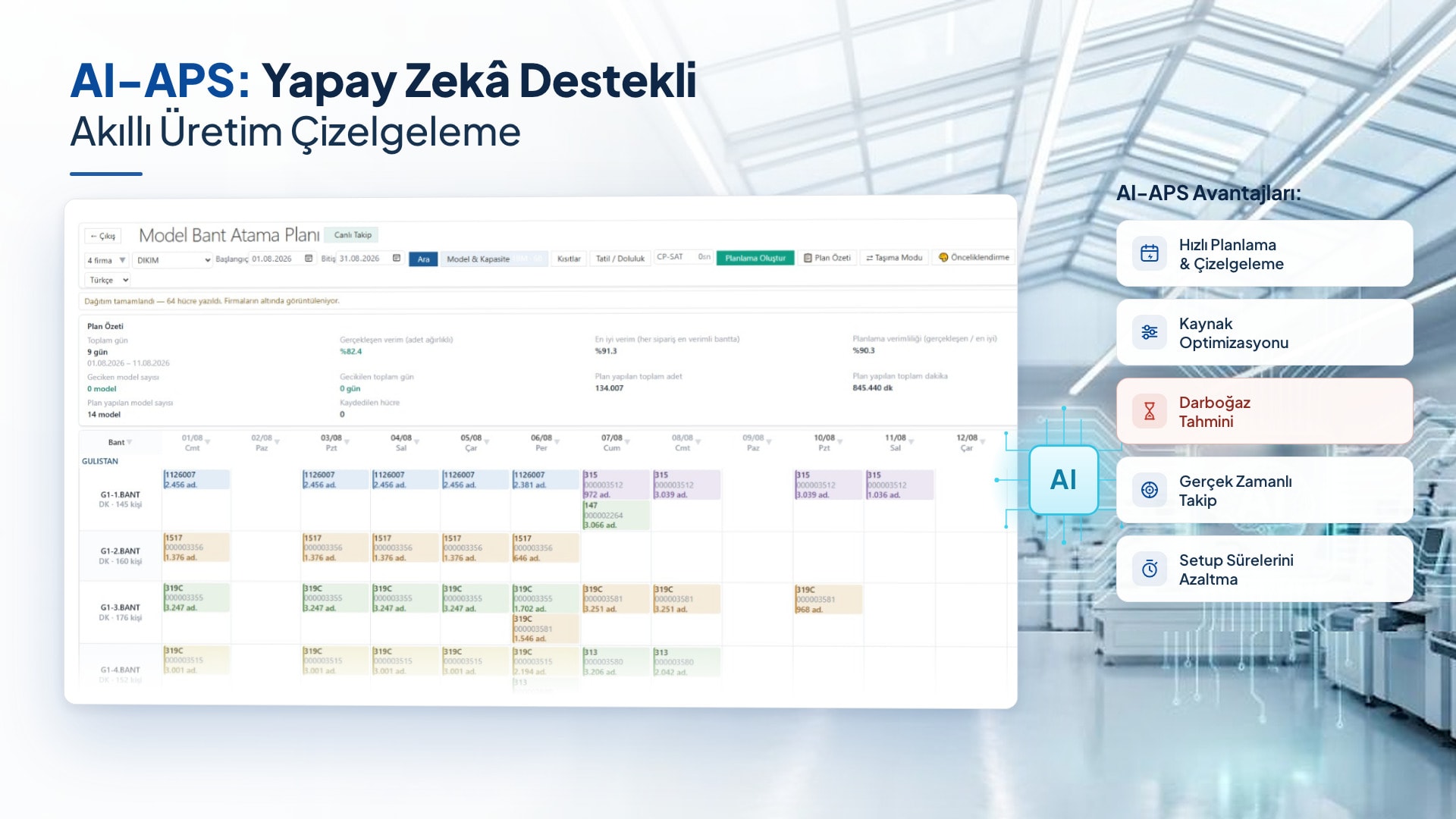
AI-APS production scheduling screen showing line-level capacity planning, plan summary and optimization output
Representative AI-APS scheduling view — line-level capacity plan and plan summary.

01 / Decision criteria

Multi-criteria production optimization

Every line performs differently per product. The same product may run at higher throughput on one line, while another line delivers better quality or a shorter run time.

  1. Order quantities and delivery dates
  2. Product-to-line suitability
  3. Current line capacity and load
  4. Historical line efficiency per product
  5. Production rates and standard times
  6. Quality performance and defect rates
  7. Line and machine constraints
  8. Product changeovers
  9. Setup times
  10. Mould, fixture and equipment changes

These inputs generate alternative production scenarios, and the schedule with the best balance of due-date compliance, efficiency, quality, capacity use and production continuity is selected.

02 / Production sequence

Setup and changeover optimization

Advanced planning is not only about placing orders into open capacity; the production sequence itself directly affects total performance.

AI-APS groups products with similar production characteristics consecutively wherever possible, to reduce mould, fixture, colour, material and machine-setting changes.

In environments with high product variety and small batch sizes, this optimization measurably reduces total production time and lost capacity.

  1. Fewer changeovers
  2. Less setup
  3. Less downtime
  4. More usable capacity

03 / Dynamic scheduling

AI-assisted dynamic scheduling

AI-APS analyses product-to-line performance relationships from past production results and keeps the schedule revisable against shop-floor conditions.

SET 01

Learned from past production

Which product family ran best on which line feeds directly into new plans.

  • Product-to-line performance relationships
  • Recorded efficiency levels
  • Quality results
  • Actual production durations
SET 02

Re-optimization triggers

The schedule can be re-optimized in these cases.

  • New order
  • Due-date change
  • Capacity loss
  • Line stoppage
  • Production deviating from plan

The result is a dynamic production schedule that updates against shop-floor conditions, rather than a static plan.

04 / Targets

Core optimization targets

AI-APS weighs these targets together with the plant's production constraints to answer the basic planning question.

  • Fastest dispatch
  • High efficiency
  • High quality
  • Low setup time
  • Fewer mould changes
  • High capacity utilization

Which order → which product → which line → which date → which production sequence

Next decision

Run the right product, on the right line, at the right time and in the right order

Use capacity more effectively, cut setup losses and raise delivery performance with AI-assisted advanced planning.

Related solutionAI-Enabled Software ModulesCustom modules for defined production problems