
When will textiles need a digital product passport?
@rgemas · · 10 min read
For textile and apparel factories that export to the EU, the digital product passport raises three questions: when will it become mandatory, who carries the obligation, and what can a factory prepare today?
This post answers them from the EU's own texts: the Ecodesign for Sustainable Products Regulation (ESPR, 2024/1781), the European Commission's 2025–2030 working plan, and the delegated and implementing acts published in 2026. Where we draw conclusions or make suggestions that the sources don't, we mark them as “our view” or “our suggestion”. The information is current as of October 2026.
The short answer
As of October 2026, a digital product passport is not yet mandatory for textile products. A separate act that the Commission will adopt for textiles is to set out which data the passport holds and when the rules apply. The Commission's working plan gives 2027 as the indicative date for adopting that act. Under the ESPR, the rules of such an act can apply no sooner than 18 months after it enters into force, barring duly justified exceptions. By our arithmetic, if the plan holds and no exception is used, the passport obligation would start in the second half of 2028 at the earliest.
Some rules for textiles already apply, though. Since 19 July 2026, large companies may no longer destroy unsold clothing, clothing accessories and footwear. The passport's infrastructure also moved in July 2026: the Commission set the operating rules for the registry and published the references of the European standards prepared for the passport.
What is a digital product passport?
The ESPR's definition starts like this:
…a set of data specific to a product…
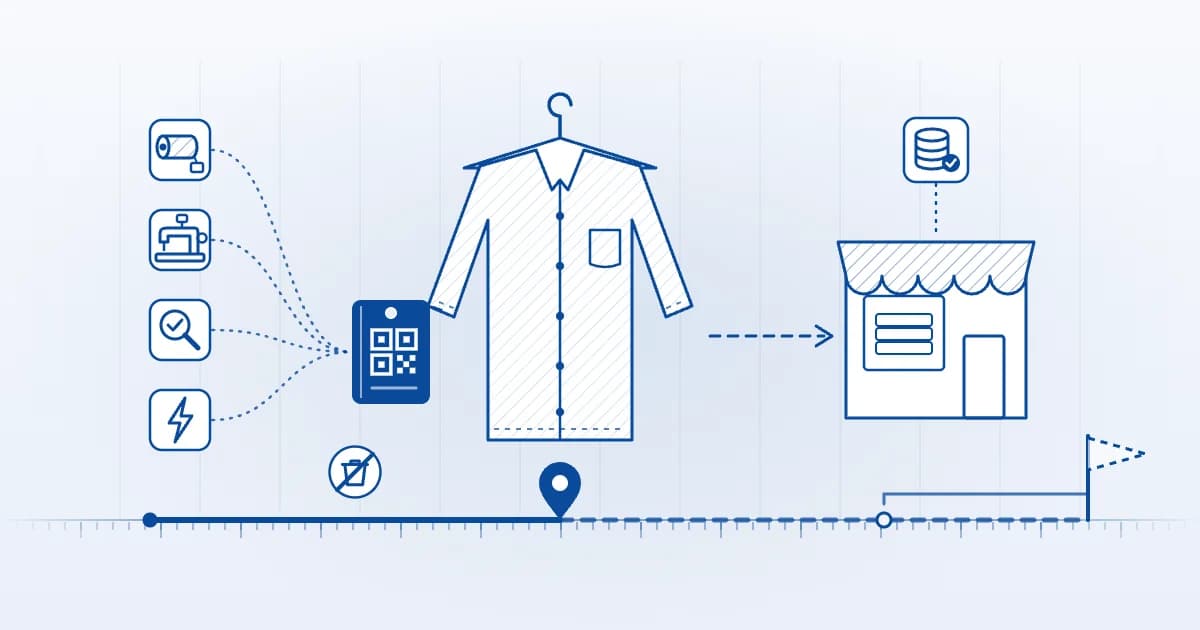
The Commission sets the details for each product group in a separate act, a so-called delegated act; in this post we call it the product-group act. According to the rest of the definition, the passport holds the information that the product-group act specifies and can be accessed electronically through a data carrier. The regulation defines a data carrier as a linear barcode, a two-dimensional symbol or another automatic identification and data capture medium that a device can read; a QR code is one example of a two-dimensional symbol. The product-group act will also decide whether the passport is kept at model, batch or item level.
We describe which data can be collected on the shop floor for the passport, and how, on our Digital Product Passport page. This post focuses on “when”, “who” and “what to prepare today”.
What already applies
The ESPR was published in the Official Journal of the EU on 28 June 2024 and entered into force on 18 July 2024. Article 18 lists the product groups the Commission had to prioritise in its first working plan, including:
…textiles, in particular garments and footwear…
The first concrete rule that affects textiles, though, concerns unsold products. Article 25 says:
…the destruction of unsold consumer products as listed in Annex VII shall be prohibited.
The ban has applied to large companies since 19 July 2026. For medium-sized companies it starts on 19 July 2030; micro and small enterprises are exempt. The list in Annex VII has two groups: apparel and clothing accessories (chapters 61 and 62 of the customs tariff, leather apparel and hats) and footwear. Home textiles such as bed linen and towels are not on the list, though the Commission can add products to it.
In its July 2026 announcement, the Commission calls the ban one of the first concrete measures under the ESPR and adds:
Textiles are the first product group subject to this ban…
The same announcement cites the European Environment Agency's estimate that between 4% and 9% of textile products placed on the European market are destroyed without ever being used: between 264,000 and 594,000 tonnes a year.
Commission Delegated Regulation (EU) 2026/296 of 9 February 2026 sets out when destruction is still allowed. Examples include unsafe products, products that infringe intellectual property rights, damaged products that cannot be repaired in a technically feasible or cost-effective way, products with design or manufacturing defects that cannot be repaired, and products offered for donation for at least eight weeks without being accepted. A company relying on these exceptions must keep the supporting documents for five years. Large companies must also publish, every year, how many unsold products they discarded and why. Implementing Regulation (EU) 2026/2, which sets a common format for that disclosure, applies from 2 March 2027. The format covers products discarded from the first full financial year after that date.
The passport's infrastructure is taking shape
Article 13 of the ESPR set a deadline for a passport registry:
By 19 July 2026, the Commission shall set up a digital registry…
Article 13 provides that the registry is to store at least the unique identifiers linked to products. Under recital 41, the passport itself should rest on a decentralised data system set up and managed by economic operators. The Commission laid down how the registry works in Implementing Regulation (EU) 2026/1778 of 16 July 2026. Under that act, only verified economic operators can register passports.
Implementing Decision (EU) 2026/1736 of 14 July 2026 published in the Official Journal the references of six harmonised European standards for the passport (EN 18216 and EN 18219 to EN 18223). They cover data exchange protocols, unique identifiers, data carriers, data storage and archiving, application programming interfaces (APIs) and system interoperability. A passport that conforms to these standards is presumed to meet the corresponding technical requirements of the regulation.
Our view: with these two steps, the passport's technical skeleton (how a product is identified and how its data is shared) is now largely settled. Which data the textile passport will hold is still open.
The textile act: what to expect
On 16 April 2025 the Commission published its ecodesign and energy labelling working plan for 2025–2030. In the plan's table of new products, textiles and apparel rank first among final products in the prioritisation by the EU's Joint Research Centre (JRC). The table gives 2027 for adopting the textile act, and the plan presents that date as an indicative timeline. The act's scope is not settled yet either. The plan's row is titled “Textiles/Apparel”; whether home textiles fall within it is for the adopted text to show.
The plan of the JRC's preparatory study on textiles, which lays the technical groundwork for the act, lists dates for three milestones; the third ran from 16 December 2025 to 30 March 2026. When we wrote this post, no date had been announced for the fourth milestone, which covers policy scenarios and the elements to be included in the passport.
The textile act will set its own date of application; Article 4 of the ESPR sets the floor. On the date of application of a product-group act, it says:
…shall not be earlier than 18 months from its entry into force…
The article allows an earlier date for the whole act or for specific requirements in duly justified cases. After adoption come the European Parliament and Council's objection period (two months, extendable by two more) and publication; the 18 months run from entry into force. Our arithmetic: if the textile act is adopted in 2027 as planned and no exception is used, the passport obligation starts in the second half of 2028 at the earliest. If the act slips, so does the date. Our view: that window is preparation time for factories.
Footwear is on a separate track
The ESPR lists footwear in the same priority item as textiles. The working plan, however, treats footwear as a separate product category because of differences in materials, functionality and supply chains, and leaves it out of the first working plan. Under the plan, a study will be commissioned to assess how much the ESPR could improve footwear's environmental sustainability. The plan gives its timing as:
…will be completed by the end of 2027.
The plan proposes to reassess the situation for the products it leaves out at the mid-term review in 2028. So there is no passport timeline for footwear yet. The destruction ban, however, already covers footwear.
Who carries the obligation?
Under the ESPR, the manufacturer is responsible for having the passport in place. Article 27 requires manufacturers placing a product on the market to ensure that:
…a digital product passport is available in accordance with Article 9 and the delegated acts…
So who is the manufacturer? The regulation defines it as a person that manufactures a product or that:
…has a product designed or manufactured, and markets that product under their name or trademark…
Our reading: the condition of marketing under one's own name or trademark applies to both cases. Article 34 also treats an importer or distributor that places a product on the market under its own name or trademark as the manufacturer. The regulation also defines an importer as an EU-based person that places a product from a non-EU country on the EU market. Under Article 29, importers too must make sure the passport is available before they place the product on the market. Which actors create the passport, and which data each may enter or update, is for the product-group act to specify (Article 9).
Our view of what this means for a Turkish supplier: if you make a product that is sold under another company's brand, that brand is the manufacturer under the regulation and is responsible for the passport. Much of the production data the passport will rely on, however, sits with you: the fabric lot and its composition, which line made the product and when, the quality records. We expect brands to ask for this data through supplier contracts and specifications. If you sell under your own brand in the EU, you are the manufacturer; if you have an EU importer, it must also make sure the passport is available.
One caveat: according to the Commission's Blue Guide on EU product rules, because of the Customs Union, in sectors where Türkiye has aligned its legislation with the EU's, a product lawfully made or marketed in Türkiye should be treated like one lawfully made or marketed in the EU. Türkiye's alignment with the ESPR is outside the scope of this post, which is why we phrase the importer sentences conditionally.
What can a factory prepare today?
There is no data list for the textile passport yet, so the checklist below is our suggestion. Its purpose is to avoid hunting for data retroactively once the list is published. The first four items follow the traceability headings on our Digital Product Passport page:
- Material: Can you link each product to the lot and supplier record of the fabric and trims used? Are the documents showing the fabric's composition and origin stored with the lot?
- Production and workforce: Can your records show which line a product was made on, which operations it went through, and when?
- Quality: Are in-line, end-of-line and final inspection records tied to the product or batch ID?
- Energy: Can you measure energy use per machine or line and allocate it to a product or batch? Product-level carbon footprint calculations rely partly on this data.
- Identity: The product-group act will decide whether the passport is kept at model, batch or item level. Our view: a factory that can trace at batch level can supply most of the production data for a model- or batch-level passport; item level also needs an identifier per product.
Our view of the best test question: starting from a product's label, how long does it take you to reach the fabric lot, the line it was sewn on and its quality record?
Where we start with argemas
On our Digital Product Passport page we group traceability under four headings: material, workforce, quality and energy. argemas MES links each operation, operator, machine, timestamp, quality reading and material lot it records during production into a genealogy tree for each product. The same data can be exported for the passport in JSON / XML. How energy data turns into a per-product carbon footprint is covered on our Carbon Footprint page.
Our view: the passport will only be as reliable as the data coming from the shop floor. We explained why shop-floor data matters so much in Factory AI is only as good as its shop-floor data and where to begin in Where to start with a smart factory.
Sources
- European Parliament and Council: Regulation (EU) 2024/1781 establishing a framework for the setting of ecodesign requirements for sustainable products (13 June 2024). Articles 2, 4, 9, 13, 18, 24, 25, 27, 29, 34 and 72, Annex VII, recital 41.
- European Commission: Ecodesign for Sustainable Products and Energy Labelling Working Plan 2025-2030, COM(2025) 187 final (16 April 2025).
- European Commission: Delegated Regulation (EU) 2026/296 (9 February 2026): derogations from the destruction ban.
- European Commission: Implementing Regulation (EU) 2026/2 (9 February 2026): format for disclosing discarded unsold products.
- European Commission: Implementing Regulation (EU) 2026/1778 (16 July 2026): digital product passport registry.
- European Commission: Implementing Decision (EU) 2026/1736 (14 July 2026): harmonised standards for digital product passports.
- European Commission, DG Environment: Ban on destruction of unsold clothes and shoes enters into application (17 July 2026).
- EU Joint Research Centre (JRC): project plan of the ecodesign preparatory study on textile products (accessed October 2026).
- European Commission: The ‘Blue Guide’ on the implementation of EU product rules 2022 (2022/C 247/01), section 2.9: the Customs Union with Türkiye.
Share this post