
Where to start with a smart factory
@rgemas · · 9 min read
“Smart factory” usually brings sensors, big screens and AI to mind. The question on a factory manager's mind is more practical: what should the first step be, and which investment prepares the ground for the next one?
In this post we look at that question through the Industrie 4.0 Maturity Index, a study by acatech, Germany's National Academy of Science and Engineering. The first edition came out in 2017. Here we use the 2020 update, edited by Günther Schuh, Reiner Anderl, Roman Dumitrescu, Antonio Krüger and Michael ten Hompel, which can be downloaded free from acatech's website. The study is written for manufacturing companies. Examples, checklist questions and readings that are not in the source are marked as our suggestion or our view.
Why do projects stall?
In the foreword, Henning Kagermann, Chairman of the acatech Board of Trustees, describes how many Industry 4.0 projects in companies are launched in response to rising competitive pressure and the growing need to tackle the digital transformation, and adds:
However, a large proportion of these projects are failing.
According to Kagermann, this is often for one of these reasons: the project doesn't contribute enough to the company's objectives, it is too focused on individual technologies, or it can't be scaled up. The study's management summary reaches the same point. Looking at Industry 4.0 purely from a technological perspective is not enough; digitalisation also requires companies to transform their organisation and culture.
Six stages: from computerisation to adaptability
The study's methodology chapter says:
The road towards Industrie 4.0 will be different for every company.
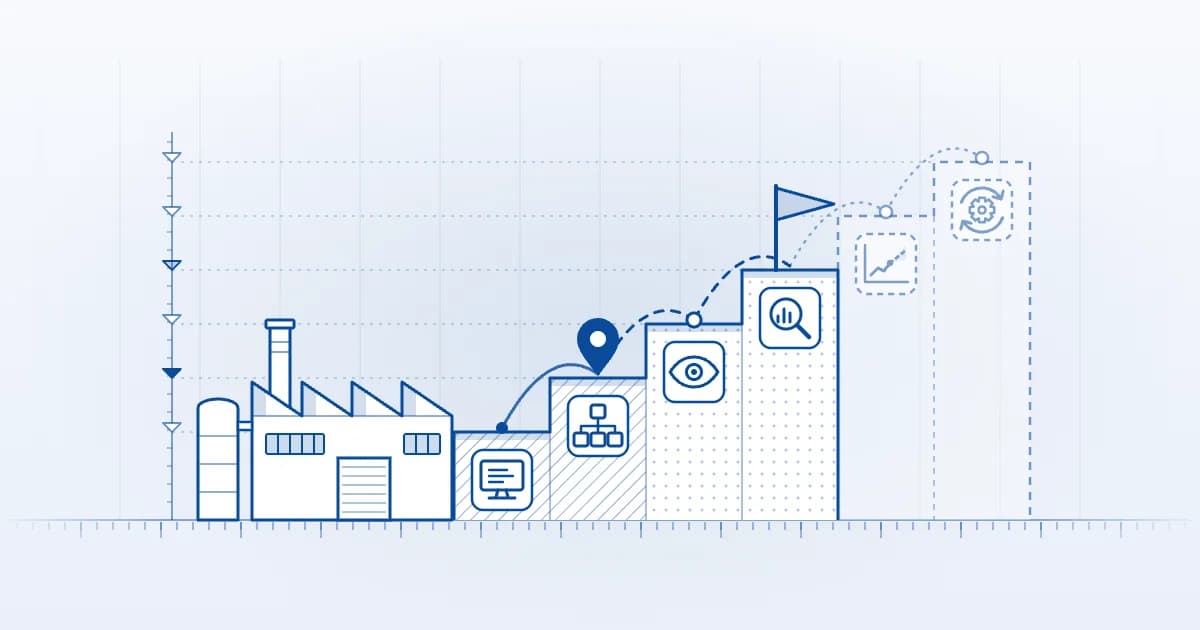
So, the authors continue, it is necessary to begin by analysing each company's current situation and goals. The framework the study proposes is a development path of six stages. Each stage builds on the previous one. The path begins with digitalisation. In the authors' view digitalisation does not itself form part of Industry 4.0; even so, the first two stages are prerequisites for Industry 4.0:
…computerisation and connectivity are basic requirements for its implementation.
In the study's diagram (FIR e. V., RWTH Aachen), each of the four later stages comes with a question: What is happening? Why is it happening? What will happen? How can an autonomous response be achieved?
1. Computerisation
Different information technologies are used in isolation from each other. The study's example will, we think, be familiar to many factories: a test station runs semi-automated quality checks, but its records are not linked to the work order they belong to. Later, it is hard to trace which order a quality issue came from. The authors also note that many machines still have no digital interface, and that in these cases terminals often provide the missing link between business applications and machines.
2. Connectivity
Widely used business applications are connected to each other and mirror the company's core processes. Parts of the operational technology (OT) are connected too, but IT and OT are not yet fully integrated. In the study's example, when a manufacturing step is finished, an MES can confirm it automatically, in real time. The authors also point out that machines 50 or more years old are still in use on the shop floor, and that new sensors can easily connect them to provide production data.
3. Visibility: What is happening?
Sensors capture processes from beginning to end with large numbers of data points, so an up-to-date digital model of the factory can be kept at all times. The study calls it the company's digital shadow and treats it as a core building block for the later stages. Many companies struggle to build one. One of the problems the authors list:
…there is usually no single source of truth – data is often held in decentralised silos.
According to the authors, functions such as production, logistics and services often still collect very little data. Their example of the benefit at this stage: the delivery date variance caused by a problem is seen quickly through real-time KPIs, the production manager adjusts the plan, and customers and suppliers are kept informed.
4. Transparency: Why is it happening?
At this stage the company starts to understand why something is happening and to produce knowledge through root cause analyses. According to the study, the captured data has to be analysed by applying engineering knowledge. Condition monitoring of machinery and equipment is an example; the authors treat transparency as a requirement for predictive maintenance.
5. Predictive capacity: What will happen?
The company can simulate different future scenarios and identify the most likely ones. Measures are still carried out manually, but seeing events in advance gives longer lead times and limits the negative impact. In our view, the authors' sentence on this stage is also a warning for anyone thinking of starting a smart factory with AI:
A company's predictive capacity is heavily dependent on the groundwork that it has previously undertaken.
According to the study, a properly built digital shadow and knowledge of the relevant interactions help ensure high-quality forecasts and recommendations based on them. We covered the same point from the AI side in Factory AI is only as good as its shop-floor data.
6. Adaptability: How can an autonomous response be achieved?
The company can delegate certain decisions to IT systems. One of the study's examples is resequencing planned orders when a machine failure is expected or a delivery delay needs to be avoided. The authors are measured here too:
It is often best only to automate individual processes.
They add that the risks of automating approvals and acknowledgements for customers and suppliers should be assessed carefully.
1. First, find out which stage you are at today
According to the study, the index is used in three steps. First, the current maturity stage is identified in the company's different functional areas. Next, a gap analysis identifies the capabilities still missing for the target stage the company chooses based on its strategy. Finally, those gaps are turned into concrete measures and a roadmap. How the evaluation is done is spelled out too:
The evaluation takes place on site at the company.
A tour of the site gives a first impression of how the processes work. Then, in a workshop, the current state is analysed through the order management process, and the capabilities for each process are rated with multiple-choice questions.
Before a formal assessment, the questions below can give a rough idea of where your factory stands within the first three stages. The questions are our suggestion; we wrote each one from the study's stage descriptions:
- Can you find, from your records, which order a quality issue occurred in?
- Who collects the data from your machines without a digital interface, and how?
- When an operation is finished, does the ERP or MES learn about it by itself, or does someone enter it?
- Can you see where an order is right now without calling anyone?
- Can you see the duration and the entered stoppage codes of yesterday's stoppages on one screen?
In our reading, if most answers are “no” or “someone types it into Excel”, your starting point is most likely the first two stages.
2. Choose the target to fit your strategy
Six stages don't mean every factory has to reach the top. According to the authors, the target stage depends on the company's business strategy, and each company decides for itself:
…which maturity stage represents the best balance between costs, capabilities and benefits…
At the time of writing, the study notes, companies were still working on the basic conditions for Industry 4.0. According to the authors, the transformation is made up of many successive steps and may move at different speeds in different businesses, plants, lines and cells.
The study's application example shows the target being set one step at a time. The index was validated in 2016 at the Espelkamp site of Harting, a manufacturer of industrial connectors. The assessment found the company at the visibility stage. The resulting roadmap contained over 30 measures across different functional areas, with transparency as the incremental goal. Measures for stages 5 and 6 are not in that roadmap; according to the study, they will be added based on a subsequent assessment.
Our suggestion is to write the target down in measurable terms: which area (for example production or logistics), which stage, by when?
3. Move technology forward together with organisation and culture
The index assesses every company in four structural areas: resources, information systems, organisational structure and culture. The authors recommend developing these four areas at a similar rate. If resources and culture are ahead while information systems and organisation lag behind, the leading areas have capabilities that cannot be taken advantage of, because the capabilities needed to use them are missing in the other two. So, as a general rule, the study recommends first bringing all four areas to the same stage, then moving on to a higher one. It notes there may be exceptions where most of the benefit can be achieved without that balance, for example predictive maintenance improvements, where effective information systems play the most critical role.
One of the assessment questions measures culture directly: what is employees' attitude towards mistakes? The lowest-level answer reads:
Errors lead to finger-pointing and are often covered up.
At the highest level, all errors without exception are analysed, appropriate measures are taken, and the effectiveness of those measures is evaluated.
In our view this question matters for shop-floor data as well. In a factory where errors are covered up, stoppage reasons are most likely entered incompletely or wrongly too; then even the best sensor cannot deliver the visibility stage on its own.
4. Start small, build to scale
According to the study, an Industry 4.0 transformation usually takes several years, so the benefits need to become visible at various points along the way. In the foreword, Kagermann sets this condition for pilot projects:
…individual pilot projects must be scalable and must deliver positive results within a short timeframe.
In the Harting example, rolling out the pilots is itself one of the production measures in the roadmap. According to the study, because the pilots run on separate production lines, they currently produce only local improvements that stay isolated and fragmented. The measure aims to integrate them into an end-to-end process across the whole of manufacturing.
Our suggestion is to tie the first pilot to a single line and a single metric, while building the data collection so it can extend to the whole factory. We covered starting with a single module in We already have SAP. Why would we need MES? and how to define success for a pilot in What to ask in an MES software demo.
Where we start with argemas
We start by measuring the current state too. Our digital transformation consultancy program starts with a maturity assessment, then builds a roadmap covering data collection, MES and ERP implementation, predictive maintenance and manufacturing data science. Once the pilot is validated, production planning, MRP, predictive maintenance and advanced analytics are introduced in stages as needed.
Other maturity models exist too. In Türkiye, the DDX model, developed by TÜBİTAK TÜSSİDE and used in the Ministry of Industry and Technology's Digital Transformation Support Program, was built to measure companies' digital maturity and prepare a company-specific roadmap. Our CEO, Hulisi Ayluçtarhan, holds DDX and DDX+ consultant certificates.
To lay out where your factory stands today, our 58-Question Factory Analysis is carried out on the shop floor. For machines without a digital interface, the terminals the study mentions are, in our case, @rgeRover and @rgeHypatia. They support keypad, touchscreen, barcode and RFID input and analog telemetry (vibration, current, temperature), and can also read PLC / OPC-UA. We describe the components of a smart factory on our Smart Factory page.
Sources
- Günther Schuh, Reiner Anderl, Roman Dumitrescu, Antonio Krüger, Michael ten Hompel (eds.): Industrie 4.0 Maturity Index. Managing the Digital Transformation of Companies – Update 2020 (acatech STUDY, 2020). Foreword: Henning Kagermann. Six-stage diagram: FIR e. V., RWTH Aachen.
Share this post